
Payrolling explained — definition, how it works, costs, and how it differs from self-employment and
EOR in Switzerland.
H
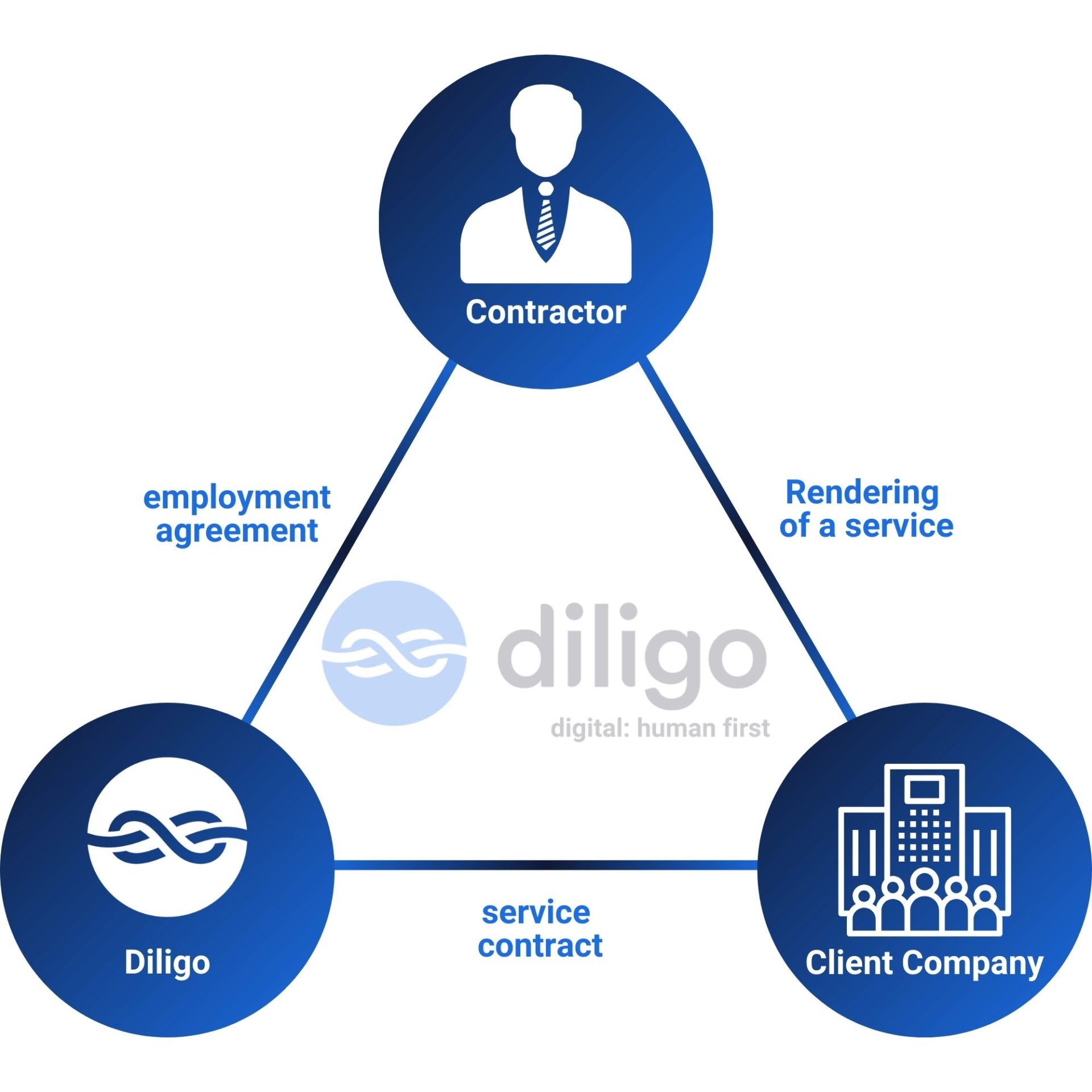
The contractor prospects his own clients and negotiates the terms of his assignment (e.g. specifications and fees).
2
Diligo signs an employment agreement with the contractor. The services provided by the contractor are invoiced to the client company by Diligo who then pays the contractor’s salary.
H
The client company signs a service contract with Diligo. This contract specifies the terms of the assignment of the contractor in the client company.
Payrolling in Switzerland usually works in three steps. First, you secure a client mandate as a contractor or consultant. Then Diligo signs the service agreement with your client and issues your Swiss employment contract. At the end of each month, your client pays Diligo, and Diligo handles the salary payment, social contributions, withholding tax, and management fee before paying you your net salary.
You receive a payslip and are covered by Swiss social security, including AHV/AVS pension, unemployment insurance (ALV), and accident insurance (UVG), just like a regular employee.
Payrolling is a Swiss employment arrangement in which a specialist company becomes the legal employer of a contractor who performs services for a third-party client. The payrolling company takes care of the employment administration, including the contract, salary payments, social security contributions, tax obligations, and other formalities, while the contractor carries out the assignment for the end client.
In Switzerland, payrolling is sometimes compared to the French portage salarial, or an umbrella company arrangement in English, but these terms are not always fully interchangeable. They describe similar structures, yet the legal framework and market practice can differ from country to country.
Three parties, one legal employment relationship
Payrolling company
Legal employerCompany / business
Legal framework: Loi sur la location de services (LSE / AVG) — supervised by SECO
Diligo holds cantonal and federal licences
Operational Flow
You (the consultant) identify a client project or are approached directly by a company.
Diligo signs a service agreement with your client and issues you a Swiss employment contract.
Your client pays Diligo. Diligo deducts AVS/AHV, ALV, UVG and its management fee, then pays you a net salary with a payslip.
AHV / AVS — retirement pension
UVG — accident insurance
ALV — unemployment insurance
LPP / BVG — occupational pension (BVG)

Payrolling offers several advantages that self-employment does not. With payrolling, there is no risk of pseudo self-employment, because Diligo acts as the legal employer and removes the risk of contractor reclassification. You also avoid the administrative burden of running your own business. Diligo manages payroll, bookkeeping, VAT threshold monitoring, and quarterly filings.
Another key difference is social security. As a self-employed person, you pay both the employer and employee AHV contributions yourself. While as a payrolled employee, contributions are shared and you benefit from unemployment insurance, which is not available to self-employed workers.
The cost of payrolling goes beyond a simple management fee. While providers charge a commission on the invoiced amount, the overall value also depends on what is included in return—such as social security contributions, pension plans, insurance coverage, and administrative support.
Your net income will vary based on factors like your tax status, selected benefits, and the level of coverage provided. Rather than focusing solely on fees, it’s important to consider the full package and the protections it offers.
Yes. Payrolling operates within the Swiss AVG/LSE framework. Diligo holds SECO and cantonal licences.
The terms are often used similarly, but umbrella company is the broader international term, while payrolling is the
term more commonly used in Switzerland. An umbrella company employs the employee and handles payroll, taxes, and administration, while the employee performs services for an end client under a tripartite setup.
Yes. Diligo specialises in cross-border payrolling for frontaliers who live in France and work in Switzerland. We
handle your Swiss employment contract and support the administrative process, including your Permis G where
applicable.
Prefer a personal touch? Schedule a call with one of our experts to discuss your needs directly.
Curious about your payroll with Diligo?
Request your salary simulation
Have questions or need more information about our payroll solutions?
Send us a message.